
Psychological Health of Undergraduate Medical Students and Its Associated Factors in A Tertiary Institution, South-South, Nigeria.
Article Sidebar
Main Article Content
Abstract
Background: The World Health Organization (WHO) highlights that many mental health conditions first appear before 24 years of age. Thus, the undergraduate period is especially crucial for the psychological health of medical students as they are a vulnerable population. This study assessed the psychological health of undergraduate medical students and its associated factors in a tertiary institution in Nigeria.
Methods: A descriptive cross-sectional study was carried out from December, 2021 to February, 2023 among 611 undergraduate medical students in the School of Medicine, University of Benin, Nigeria, using stratified random sampling. Data were collected using a semi-structured self-administered questionnaire adapting the General Health Questionnaire (GHQ-28). Univariate and Bivariate analysis was done using IBM SPSS Statistics Version 25 software.
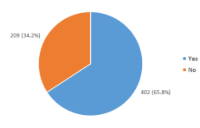
Results: Two-thirds of respondents were at increased risk of psychological ill-health, 402 (65.8%), having had a GHQ-28 score of 4 and above. A statistically significant relationship was also found between course satisfaction and psychological health as majority 134 (74.0%) of respondents who were dissatisfied were at increased risk of psychological ill-health (p-value = 0.005).
Conclusion: The risk of psychological ill-health was high among undergraduate medical students. Various sociodemographic, socioeconomic and academic factors influenced their risk of psychological ill-health. Consequently, fostering the psychological health of medical students becomes an imperative, directly cultivating a resilient and effective future healthcare workforce.
Downloads
Article Details
Section

This work is licensed under a Creative Commons Attribution-NonCommercial-ShareAlike 4.0 International License.
The Journal is owned, published and copyrighted by the Nigerian Medical Association, River state Branch. The copyright of papers published are vested in the journal and the publisher. In line with our open access policy and the Creative Commons Attribution License policy authors are allowed to share their work with an acknowledgement of the work's authorship and initial publication in this journal.
This is an open access journal which means that all content is freely available without charge to the user or his/her institution. Users are allowed to read, download, copy, distribute, print, search, or link to the full texts of the articles in this journal without asking prior permission from the publisher or the author.
The use of general descriptive names, trade names, trademarks, and so forth in this publication, even if not specifically identified, does not imply that these names are not protected by the relevant laws and regulations. While the advice and information in this journal are believed to be true and accurate on the date of its going to press, neither the authors, the editors, nor the publisher can accept any legal responsibility for any errors or omissions that may be made. The publisher makes no warranty, express or implied, with respect to the material contained herein.
TNHJ also supports open access archiving of articles published in the journal after three months of publication. Authors are permitted and encouraged to post their work online (e.g, in institutional repositories or on their website) within the stated period, as it can lead to productive exchanges, as well as earlier and greater citation of published work (See The Effect of Open Access). All requests for permission for open access archiving outside this period should be sent to the editor via email to editor@tnhjph.com.
How to Cite
References
World Health Organization. Mental Health of Adolescents [Internet]. World Health Organization. 2024. Available from: https://www.who.int/news-room/fact-sheets/detail/adolescent-mental-health
Jalal Poorolajal, Ghaleiha A, Nahid Darvishi, Shahla Daryaei, Panahi S. The Prevalence of Psychiatric Distress and Associated Risk Factors among College Students Using GHQ-28 Questionnaire. DOAJ (DOAJ: Directory of Open Access Journals). 2017 Jul 1;46(7):957–63.
Stirparo G, Pireddu R, D’Angelo M, Bottignole D, Mazzoli R, Gambolò L. Is Mental Health Worse in Medical Students than in the General Population? A Cross-Sectional Study. Medicina [Internet]. 2024 Jun 1;60(6):863. Available from: https://www.mdpi.com/1648-9144/60/6/863
Mirza AA, Milaat WA, Ramadan IK, Baig M, Elmorsy SA, Beyari GM, et al. Depression, anxiety and stress among medical and non-medical students in Saudi Arabia: An epidemiological comparative cross-sectional study. Neurosciences Journal [Internet]. 2021 Apr 1;26(2):141–51. Available from: https://nsj.org.sa/content/26/2/141.abstract
Adhikari A, Dutta A, Sapkota S, Chapagain A, Aryal A, Pradhan A. Prevalence of poor mental health among medical students in Nepal: a cross-sectional study. BMC Medical Education. 2017;17(1):1-7.
Jafari N, Loghmani A, Montazeri A. Mental health of Medical Students in Different Levels of Training. International Journal of Preventive Medicine.2012; Special Issue, S107-12.
Abdulghani, H. M., AlKanhal, A. A., Mahmoud, E. S., Ponnamperuma, G. G., & Alfaris, E. A. (2011). Stress and Its Effects on Medical Students: A Cross-sectional Study at a College of Medicine in Saudi Arabia. Journal of Health, Population and Nutrition, 29(5), 516–522. https://doi.org/10.3329/jhpn.v29i5.8906
Dyrbye LN, Thomas MR, Shanafelt TD. Medical Student Distress: Causes, Consequences, and Proposed Solutions. Mayo Clinic Proceedings. 2005 Dec;80(12):1613–22.
Auerbach RP, Alonso J, Axinn WG, Cuijpers P, Ebert DD, Green JG, et al. Mental disorders among college students in the World Health Organization World Mental Health Surveys. Psychological Medicine [Internet]. 2016 Aug 3;46(14):2955–70. Available from: https://www.cambridge.org/core/journals/psychological-medicine/article/mental-disorders-among-college-students-in-the-world-health-organization-world-mental-health-surveys/34942DEAFC35899349114B73E84FB080
Stallman HM. Psychological distress in university students: A comparison with general population data. Australian Psychologist [Internet]. 2010 Nov 6;45(4):249–57. Available from: https://www.tandfonline.com/doi/full/10.1080/00050067.2010.482109
Melaku L, Mossie A, Negash A. Stress among Medical Students and Its Association with Substance Use and Academic Performance. Journal of Biomedical Education. 2015;2015:1-9.
Yusoff M, Mat Pa M, Esa A, Abdul Rahim A. Mental health of medical students before and during medical education: A prospective study. Journal of Taibah University Medical Sciences. 2013;8(2):86-92.
Ofili AN, Oriaifo I, Okungbowa E, Eze EU. Stress and psychological health of medical students in a Nigerian university. Niger J Clin Pract. 2009 Jun;12(2):128-33. PMID: 19764658.
Oku A, Oku O, Owoaje E, Monjok E. An Assessment of Mental Health Status of Undergraduate Medical Trainees in the University of Calabar, Nigeria: A Cross-Sectional Study. Open Access Macedonian Journal of Medical Sciences. 2015;3(2):356-362.
Jaykaran C, Tamaoghna B. How to Calculate Sample Size for Different Study Designs in Medical Research. Indian Journal of Psychological Medicine. 2013.35(2): 121-126. Available from: https://www.ncbi.nlm.nih.gov/pmc/articles/PMC3775042. DOI: 10.4103/0253-7176.116232.
Chen M. Sample size determination: the fundamentals of international clinical research workshop. Family Health International. 2004: 1-18.
Part 2: Planning and Set Up 2-2-1 Section 2: Preparing the Sample WHO STEPS Surveillance Section 2: Preparing the Sample Overview [Internet]. Available from: https://cdn.who.int/media/docs/default-source/ncds/ncd-surveillance/steps/part2-section2.pdf?sfvrsn=9c33a896_2
Liang Y, Wang L, Yin X. The factor structure of the 12-item general health questionnaire (GHQ-12) in young Chinese civil servants. Health and Quality of Life Outcomes. 2016;14(1):1-9.
28-Item General Health Questionnaire [Internet]. Physiopedia. 2020 [cited 4 September 2021]. Available from: https://www.physio-pedia.com/28-Item_General_Health_Questionnaire.
General Health Questionnaire [Internet]. GL Education. [cited 9 September 2021]. Available from: https://www.gl-education.com/assessments/products/general-health-questionnaire/.
McDermott A. General Health Questionnaire – 28 (GHQ-28) – Strokengine [Internet]. Strokengine.ca. 2015 [cited 4 September 2021]. Available from: https://strokengine.ca/en/assessments/general-health-questionnaire-28-ghq-28/.
Farahangiz S, Mohebpour F, Salehi A. Assessment of mental health among Iranian Medical Students: A cross-sectional study. International Journal of Health Sciences. 2016;10(1):49–54.