
Seroprevalence of Lassa Virus Infection and Associated Risk Factors in North-Central Nigeria: A Community-Based Multi-State Study
Article Sidebar
Main Article Content
Abstract
Background: Lassa fever remains a major public health threat in West Africa, with Nigeria accounting for the highest burden of disease. However, the true extent of population-level exposure is poorly defined, particularly in North-Central Nigeria.
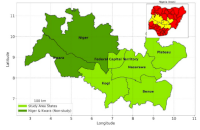
Methods: A community-based cross-sectional seroprevalence of LASV was conducted across five states in North-Central Nigeria (Benue, Kogi, Nasarawa, Plateau, and the Federal Capital Territory-FCT) between January and July 2024. A total of 958 participants were enrolled using a multistage sampling method. Serum samples were tested for LASV-specific IgG and IgM antibodies using a validated recombinant nucleoprotein enzyme-linked immunosorbent assay. All IgM-positive samples and a random subset of IgM-negative samples underwent RT-PCR testing for the detection of active infection. Standardised questionnaires captured sociodemographic, environmental, and behavioural exposures. Multivariable logistic regression was used to identify factors independently associated with seropositivity.
Results: IgM seroprevalence was low (1.15%), and all 91 samples tested by RT-PCR were negative. In multivariable analysis, participants from FCT (adjusted odds ratio [aOR] 0.07, 95% CI 0.03–0.15), Kogi (aOR 0.05, 95% CI 0.02–0.14), Nasarawa (aOR 0.18, 95% CI 0.09–0.40), and Plateau (aOR 0.22, 95% CI 0.10–0.49) had significantly lower odds of IgG seropositivity compared to Benue State. Living in non-concrete houses was associated with increased odds of seropositivity (aOR 2.66, 95% CI 1.79–3.95). In contrast, rodent consumption was associated with reduced odds of seropositivity (aOR 0.23, 95% CI 0.12–0.44).
Conclusion: LASV exposure is widespread but heterogeneously distributed across North-Central Nigeria, with strong influence from geographical and housing-related factors.
Downloads
Article Details
Section

This work is licensed under a Creative Commons Attribution-NonCommercial-ShareAlike 4.0 International License.
The Journal is owned, published and copyrighted by the Nigerian Medical Association, River state Branch. The copyright of papers published are vested in the journal and the publisher. In line with our open access policy and the Creative Commons Attribution License policy authors are allowed to share their work with an acknowledgement of the work's authorship and initial publication in this journal.
This is an open access journal which means that all content is freely available without charge to the user or his/her institution. Users are allowed to read, download, copy, distribute, print, search, or link to the full texts of the articles in this journal without asking prior permission from the publisher or the author.
The use of general descriptive names, trade names, trademarks, and so forth in this publication, even if not specifically identified, does not imply that these names are not protected by the relevant laws and regulations. While the advice and information in this journal are believed to be true and accurate on the date of its going to press, neither the authors, the editors, nor the publisher can accept any legal responsibility for any errors or omissions that may be made. The publisher makes no warranty, express or implied, with respect to the material contained herein.
TNHJ also supports open access archiving of articles published in the journal after three months of publication. Authors are permitted and encouraged to post their work online (e.g, in institutional repositories or on their website) within the stated period, as it can lead to productive exchanges, as well as earlier and greater citation of published work (See The Effect of Open Access). All requests for permission for open access archiving outside this period should be sent to the editor via email to editor@tnhjph.com.
How to Cite
References
1.World Health Organization. Lassa fever fact sheet. Geneva: WHO; 2025.
2.McCormick JB, Fisher-Hoch SP. Lassa fever. In: Oldstone MBA, editor. Arenaviruses I. Berlin: Springer; 2002. p. 75–109.
3.Nigeria Centre for Disease Control. Lassa fever situation report 2024. Abuja: NCDC; 2024.
4.Monath TP, Newhouse VF, Kemp GE, Setzer HW, Cacciapuoti A. Lassa virus isolation from Mastomys natalensis rodents during an epidemic in Sierra Leone. Science. 1974;185(4147):263–5.
5.Happi AN, Olumade TJ, Ogunsanya OA, Sijuwola AE, Oguzie JU, Oluniyi PE, et al. Increased prevalence of Lassa fever virus-positive rodents and diversity of infected species during human Lassa fever epidemics in Nigeria. Microbiol Spectr. 2022;10(4):e0036622.
6.Omotehinwa TO, Edegbene AO, Audu O, Abah SO, Shittu OS, Agbo EB, Ujah IAO, Idoko JA, Anejo-Okopi J. Modelling household, behavioural, and environmental determinants of Lassa virus exposure using formative risk indices. Zoonotic Dis. 2026; 6:8. doi:10.3390/zoonoticdis6010008.
7.Edegbene AO, Omotehinwa TO, Anejo-Okopi J, Yaagoubi SE, Shittu OS, Audu O, et al. Serological evidence of Lassa virus exposure in non-Mastomys small mammals within a hyperendemic region of North-Central Nigeria: a pilot study. Viruses. 2025;17(10):1368.
8.Bamidele OO. Epidemiology of Lassa fever in Nigeria, 2015–2025: a descriptive study. J Infect Dis. 2025;1(9):1–9.
9.Eneh SC, Obi CG, Ephraim IU, Okon IJ, Udom GU, Bassey IA, et al. The resurgence of Lassa fever in Nigeria: economic impact, challenges, and strategic public health interventions. Front Public Health. 2025; 13:1574459.
10.Asogun D, Arogundade B, Unuabonah F, Oladipo EK, Ogunlade S, Fowotade A, et al. Review of the epidemiology of Lassa fever in Nigeria. Microorganisms. 2025;13(6):1419.
11.Tiamiyu AB, Adegbite OA, Freides O, Ogunleye OO, Afolabi MO, Okoeguale J, et al. Seroprevalence and risk factors for Lassa virus infection in South-West and North-Central Nigeria: a community-based cross-sectional study. BMC Infect Dis. 2024;24(1):1118.
12.Nigeria Centre for Disease Control. Lassa fever situation report 2025 (week 46). Abuja: NCDC; 2025.
13.Ogundele GO, Jolayemi KO, Bello S. Lassa fever in West Africa: a systematic review and metaanalysis of attack rates, case fatality rates and risk factors. BMC Public Health. 2025;25(1):2948.
14.Moore SM, Rapheal E, Mendoza GS, Lo Iacono G, Grant DS, Schieffelin JS, et al. Estimation of Lassa fever incidence rates in West Africa: development of a modelling framework to inform vaccine trial design. PLoS Negl Trop Dis. 2025;19(7):e0012751.
15.Richmond JK, Baglole DJ. Lassa fever: epidemiology, clinical features, and social consequences. BMJ. 2003;327(7426):1271–5.
16.Ogbu O, Ajuluchukwu E, Uneke CJ. Lassa fever in West African sub-region: an overview. J Vector Borne Dis. 2007;44(1):1–11.
17.Gabriel M, Adomeh DI, Ehimuan J, Oyakhilome J, Ogbaini-Emovon E, Olomu SC, et al. Development and evaluation of antibody-capture immunoassays for detection of Lassa virus nucleoprotein-specific immunoglobulin M and G. PLoS Negl Trop Dis. 2018;12(3):e0006361.
18.Fichet-Calvet E, Rogers DJ. Risk maps of Lassa fever in West Africa. PLoS Negl Trop Dis. 2009;3(3):e388.
19.Kayem ND, Okogbenin S, Okoeguale J, Asogun D, Akhideno P, Okonofua M, et al. Seroepidemiology of Lassa virus in pregnant women in Southern Nigeria: a prospective hospital-based cohort study. PLoS Negl Trop Dis. 2023;17(5):e0011350.
20.Abongwa LE, Njefi K, Tamanjong CD, Nfor EG, Ashu NE, Nchang WA, et al. Detection of Immunoglobulin G and/or IgM antibodies specific for Lassa virus among HIV patients in the Northwestern region of Cameroon. Virol J. 2025;22(1):125.
21.World Medical Association. World Medical Association Declaration of Helsinki: ethical principles for medical research involving human subjects. JAMA. 2013;310(20):2191–4.
22.Cochran WG. Sampling techniques. 3rd ed. New York: John Wiley & Sons; 1977.
23.Lwanga SK, Lemeshow S. Sample size determination in health studies: a practical manual. Geneva: World Health Organization; 1991.
24.Dimas HJ, Sambo NM, Ibrahim MS, Ajayi IO, Ajumobi OO, Nguku PM, et al. Coverage of indoor residual spraying for malaria control and factors associated with its acceptability in Nasarawa State, North-Central Nigeria. Pan Afr Med J. 2019;33:84.
25.Tindana PO, Singh JA, Tracy CS, Upshur RE, Daar AS, Singer PA, et al. Grand challenges in global health: community engagement in research in developing countries. PLoS Med. 2007;4(9):e273.
26.Eisen L, Eisen RJ. Using geographic information systems and decision support systems for the prediction, prevention, and control of vectorborne diseases. Annu Rev Entomol. 2011;56:41– 61.
27.Bonner PC, Schmidt WP, Belmain SR, Oshin B, Baglole D, Borchert M. Poor housing quality increases risk of rodent infestation and Lassa fever in rural communities of Sierra Leone. Am J Trop Med Hyg. 2007;77(5):954–8.
28.World Health Organization. WHO guidelines on drawing blood: best practices in phlebotomy. Geneva: WHO; 2010.
29.Gabriel M, Adomeh DI, Ehimuan J, Oyakhilome J, Ogbaini-Emovon E, Olomu SC, et al. Development and evaluation of antibody-capture immunoassays for detection of Lassa virus nucleoprotein-specific immunoglobulin M and G. PLoS Negl Trop Dis. 2018;12(3):e0006361.
30.Bundo K, Kato H, Yamada K, Nwafor CD, Umeokonkwo CD, Anjorin OO, et al. Seroprevalence of Lassa virus in healthcare workers and community members in Nigeria. J Infect Dis. 2023;228(5):612–20.
31.Asogun DA, Adomeh DI, Ehimuan J, Odia I, Hass M, Gabriel M, et al. Molecular diagnostics for Lassa fever at Irrua Specialist Teaching Hospital, Nigeria: lessons learnt from two years of laboratory operation. PLoS Negl Trop Dis. 2012;6(9):e1839.
32.Nikisins S, Rieger T, Patel P, Müller R, Günther S, Niedrig M. International external quality assessment study for molecular detection of Lassa virus. PLoS Negl Trop Dis. 2015;9(5):e0003793.
33.Olschlager S, Lelke M, Emmerich P, Panning M, Drosten C, Hass M, et al. Improved detection of Lassa virus by reverse transcription-PCR targeting the 5' region of S RNA. J Clin Microbiol. 2010;48(6):2009–13.
34.World Health Organization. Guidance on regulations for the transport of infectious substances 2021-2022. Geneva: WHO; 2021.
35.International Air Transport Association. Dangerous goods regulations. 63rd ed. Montreal: IATA; 2022.
36.Irrua Specialist Teaching Hospital. Institute of Viral and Emerging Pathogens Control and Research annual report. Irrua: ISTH; 2023.
37.Harris PA, Taylor R, Thielke R, Payne J, Gonzalez N, Conde JG. Research electronic data capture (REDCap) a metadata-driven methodology and workflow process for providing translational research informatics support. J Biomed Inform. 2009;42(2):377–81.
38.StataCorp. Stata statistical software: release 17. College Station, TX: StataCorp LLC; 2021.
39.Altman DG. Practical statistics for medical research. London: Chapman and Hall; 1991.
40.Newcombe RG. Two-sided confidence intervals for the single proportion: comparison of seven methods. Stat Med. 1998;17(8):857–72.
41.Agresti A. Categorical data analysis. 3rd ed. Hoboken, NJ: John Wiley & Sons; 2013.
42.Hosmer DW, Lemeshow S, Sturdivant RX. Applied logistic regression. 3rd ed. Hoboken, NJ: John Wiley & Sons; 2013.
43.Greenland S. Modeling and variable selection in epidemiologic analysis. Am J Public Health. 1989;79(3):340–9.
44.Kutner MH, Nachtsheim CJ, Neter J, Li W. Applied linear statistical models. 5th ed. New York: McGraw-Hill; 2005.
45.World Health Organization. Laboratory quality management system: handbook. Geneva: WHO; 2011.
46.Westgard JO. Basic quality control practices. 4th ed. Madison, WI: Westgard QC; 2018.
47.World Health Organization. Benue State: WHO expands Lassa fever response with community-level outreach campaigns [Internet]. 2025 [cited 2026 Apr 4]. Available from: https://www.afro.who.int/countries/nigeria/news/benue-state-who-expands-lassa-fever-response-community-level-outreach-campaigns
48.Nigeria Centre for Disease Control and Prevention. Lassa fever situation report: Epi Week 11, 2026 [Internet]. Abuja: NCDC; 2026 [cited 2026 Apr 4]. Available from: https://ncdc.gov.ng/themes/common/files/sitreps/83306284bfecdf4a04cdebfbe7d462a8.pdf
49.Mbaave TP, Onyilo O, Echekwube PO, Swende TZ, Igbah TI. Lassa fever: patients’ profile and treatment outcomes at Benue State University Teaching Hospital Makurdi, North-Central Nigeria. Adv Infect Dis. 2023;13(4):58. doi:10.4236/aid.2023.134058
50.Bonwitt J, Sáez AM, Lamin J, Ansumana R, Dawson M, Buanie J, et al. At home with Mastomys and Rattus: human–rodent interactions and potential for primary transmission of Lassa virus in domestic spaces. Am J Trop Med Hyg. 2017;96(4):935–43. doi:10.4269/ajtmh.16-0675
51.Taboe HB, Pilyugin SS, Ngonghala CN. Revealing hidden drivers of Lassa fever through a model-informed approach for reproducing and predicting disease dynamics and guiding control strategies. Sci Rep. 2025; 15:33786. doi:10.1038/s41598-025-01176-y
52.Uppala PK, Karanam SK, Kandra NV, Edhi S. Lassa fever: a comprehensive review of virology, clinical management, and global health implications. World J Virol. 2025;14(3):108405. doi:10.5501/wjv.v14.i3.108405
53.McCormick JB, Webb PA, Krebs JW, Johnson KM, Smith ES. A prospective study of the epidemiology and ecology of Lassa fever. J Infect Dis. 1987;155(3):437–44.
54.Kamara ABS, Moseray A, Fatoma P, et al. Socioeconomic and environmental predictors of Lassa fever transmission in Lower Bambara Chiefdom, Kenema District, Eastern Sierra Leone. BMC Public Health. 2025; 25:3710. doi:10.1186/s12889-025-24973-6
55.Madaki PD, Husaini DC, Frazzoli C, Nwokocha CR, Orisakwe OE. Understanding Lassa fever through a One Health lens: how climate, land use, and poverty shape transmission in Nigeria. The Microbe. 2026; 10:100649. doi:10.1016/j.microb.2026.100649
56.Kobie AG, Okeibunor JC, Gonah L. Risk factors and determinants of Lassa fever transmission in Eastern Sierra Leone. J Glob Health Econ Policy. 2025;5:e2025021. doi:10.52872/001c.142074
57.World Health Organization. Ebola virus disease: manual for safe and dignified burial. Geneva: WHO; 2014.
58.Tiffany A, Dalziel BD, Kagume Njenge H, Johnson G, Nugba Ballah R, James D, et al. Estimating the number of secondary Ebola cases resulting from an unsafe burial and risk factors for transmission during the West Africa Ebola epidemic. PLoS Negl Trop Dis. 2017;11(6):e0005491.
59.Asogun DA, Adomeh DI, Ehimuan J, Odia I, Hass M, Gabriel M, et al. Molecular diagnostics for Lassa fever at Irrua Specialist Teaching Hospital, Nigeria: lessons learnt from two years of laboratory operation. PLoS Negl Trop Dis. 2012;6(9):e1839.
60.World Health Organization. Lassa fever fact sheet. Geneva: WHO; 2017.
61.Salami K, Gouglas D, Schmaljohn C, Saville M, Tornieporth N. A review of Lassa fever vaccine candidates. Curr Opin Virol. 2019; 37:105–11.