
Knowledge, Attitudes, and Practices of AI-Assisted Diagnostics Among Students of Master of Public Health in Ahmadu Bello University, Zaria, Nigeria
Article Sidebar
Main Article Content
Abstract
Background: Integrating artificial intelligence (AI) into healthcare has transformed disease diagnostics, offering opportunities to enhance accuracy, efficiency, and accessibility. However, adopting AI-assisted diagnostics depends significantly on future public health professionals' knowledge, attitudes, and practices (KAP). This study assessed the KAP of students of Master of Public Health (MPH) at Ahmadu Bello University (ABU), Nigeria, regarding AI-assisted diagnostics in healthcare, including the gaps in the current MPH curriculum concerning AI literacy.
Methods: The study adopted a quantitative cross-sectional descriptive survey design. Data from 205 ABU MPH students recruited via simple random sampling were collected using researcher-constructed 16-item questionnaires, organized into four sections, and sent via email on Google Form. KAP were measured on 3-point Likert scale. The collected data were analyzed in descriptive statistics using SPSS version 28.
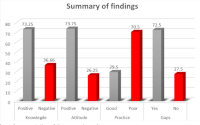
Results: The response rate was 99%. The findings revealed moderate levels of knowledge about AI tools (73.3%), positive attitudes toward their use (73.8%), but limited practical experience and dissatisfaction (29.5%) with the current level of AI training in the MPH curriculum. Students supported incorporating AI-related courses and experiential learning opportunities into MPH program (72.5%).
Conclusion: These results highlight the need for targeted interventions to enhance AI literacy among MPH students and prepare them for the ethical and practical integration of AI technologies in healthcare. The study contributes to the discourse on modernizing public health education and provides actionable recommendations for policymakers, educators, and healthcare institutions. Future research should explore longitudinal trends and cross-cultural perspectives to inform AI adoption strategies in public health practice.
Downloads
Article Details
Section

This work is licensed under a Creative Commons Attribution-NonCommercial-ShareAlike 4.0 International License.
The Journal is owned, published and copyrighted by the Nigerian Medical Association, River state Branch. The copyright of papers published are vested in the journal and the publisher. In line with our open access policy and the Creative Commons Attribution License policy authors are allowed to share their work with an acknowledgement of the work's authorship and initial publication in this journal.
This is an open access journal which means that all content is freely available without charge to the user or his/her institution. Users are allowed to read, download, copy, distribute, print, search, or link to the full texts of the articles in this journal without asking prior permission from the publisher or the author.
The use of general descriptive names, trade names, trademarks, and so forth in this publication, even if not specifically identified, does not imply that these names are not protected by the relevant laws and regulations. While the advice and information in this journal are believed to be true and accurate on the date of its going to press, neither the authors, the editors, nor the publisher can accept any legal responsibility for any errors or omissions that may be made. The publisher makes no warranty, express or implied, with respect to the material contained herein.
TNHJ also supports open access archiving of articles published in the journal after three months of publication. Authors are permitted and encouraged to post their work online (e.g, in institutional repositories or on their website) within the stated period, as it can lead to productive exchanges, as well as earlier and greater citation of published work (See The Effect of Open Access). All requests for permission for open access archiving outside this period should be sent to the editor via email to editor@tnhjph.com.
How to Cite
References
1. Smith J, Brown R, Green L. Ensuring fairness in AI-driven healthcare: A review of current practices. Equity Health. 2022;8(2):78-92.
2.Adams J, Brown R, Clark M. Artificial intelligence in healthcare: Attitudes and perceptions among public health professionals. Healthc Technol Rev. 2022;14(3):112-126.
3.Alowais SA, Alghamdi SS, Alsuhebany N, Alqahtani T, Alshaya AI, Almohareb SN, et al. Revolutionizing healthcare: the role of artificial intelligence in clinical practice. BMC Medical Education [Internet]. 2023;23(1). Available from: https://bmcmededuc.biomedcentral.com/articles/10.1186/s12909-023-04698-z
4.Fritsch SJ, Blankenheim A, Wahl A, Hetfeld P, Maassen O, Deffge S, et al. Attitudes and perception of artificial intelligence in healthcare: A cross-sectional survey among patients. Digital Health [Internet]. 2022; 1; 8:205520762211167. Available from: https://pmc.ncbi.nlm.nih.gov/articles/PMC9380417/.
5.Laupichler MC, Aster A, Meyerheim M, Raupach T, Mergen M. Medical students’ AI literacy and attitudes towards AI: a cross-sectional two-center study using pre-validated assessment instruments. BMC Medical Education [Internet]. 2024; 24(1). Available from: https://pmc.ncbi.nlm.nih.gov/articles/PMC11007897/#Sec1.
6.Martinez R, Thompson G, White D. Knowledge gaps in AI among public health students: Implications for training programs. Public Health Learn. 2022;5(2):89-102.
7.Chen L, Wang H, Liu X. Digital health literacy: A critical competency for public health education in the 21st century. Int J Public Health Educ. 2022;7(1):78-92.
8.Okafor E, Nwankwo U, Obi A. Leveraging AI for healthcare transformation in sub-Saharan Africa. Afr J Health Technol. 2023;6(2):29-43.
9.Taylor R, Green L. Ethical considerations in AI adoption: Perspectives from public health professionals. Bioeth Health Policy. 2022;7(2):91-104.
10.Ahmadu Bello University, Distance learning center [ABUDL]. About us. 2025-3-25Available at https://abudlc.edu.ng/about-us/
11.Ahmadu Bello University. Postgraduate student enrollment records 2023/2024. Unpublished institutional data. Zaria, Nigeria: Ahmadu Bello University; 2023.
12.Yamane T. Statistics: An introductory analysis. 2nd ed. New York: Harper & Row; 1967.
13.Salama N, Bsharat R, Alwawi A, Khlaif ZN. Knowledge, attitudes, and practices toward AI technology (ChatGPT) among nursing students at Palestinian universities. BMC Nursing [Internet]. 202524(1). Available from: https://bmcnurs.biomedcentral.com/articles/10.1186/s12912-025-02913-4
14.Amin MHJ, Elmahi MAME, Abdelmonim GA, Fadlalmoula GA, Amin JHJ, Alrabee NHK, et al. Knowledge, attitude, and practice of artificial intelligence among medical students in Sudan: A cross-sectional study. Annals of Medicine and Surgery [Internet]. 2024-4-2024; Available from: https://journals.lww.com/annals-of-medicine-and-surgery/fulltext/2024/07000/knowledge,_attitude,_and_practice_of_artificial.23.aspx
15.The Reality of AI in Healthcare: Supplement, Not Substitute|Shiftmed Blog [Internet]. 2024. Available from: https://www.shiftmed.com/insights/knowledge-center/the-reality-of-ai-in-healthcare-supplement-not-substitute/
16.Gala D, Behl H, Shah M, Makaryus AN. The Role of Artificial Intelligence in Improving Patient Outcomes and Future of Healthcare Delivery in Cardiology: A Narrative Review of the Literature. Healthcare [Internet]. 202412(4):481. Available from: https://pmc.ncbi.nlm.nih.gov/articles/PMC10887513/
17.Daly SJ, Wiewiora A, Hearn G. Shifting attitudes and trust in AI: Influences on organizational AI adoption. Technological Forecasting and Social Change [Internet]. 2025;19; 215:124108. Available from: https://www.sciencedirect.com/science/article/pii/S0040162525001398
18.Sezgin E. Artificial intelligence in healthcare: Complementing, not replacing, doctors and healthcare providers. Digital Health [Internet]. 2023;9. Available from: https://pmc.ncbi.nlm.nih.gov/articles/PMC10328041/
19.James A. How Artificial Intelligence is Disrupting Medicine and What it Means for Physicians [Internet]. HMS Postgraduate Education. 2023. Available from: https://postgraduateeducation.hms.harvard.edu/trends-medicine/how-artificial-intelligence-disrupting-medicine-what-means-physicians
20.Sadiq F, Sadiq F, Gul R, Zuhra F, Khan MK, Shah SMA, et al. Knowledge, Attitude, and Practice (KAP) Regarding the Use of Artificial Intelligence in Hospital Settings in Mardan, Khyber Pakhtunkhwa, Pakistan. Cureus [Internet]. 2024 Available from: https://pubmed.ncbi.nlm.nih.gov/39781175/
21.Khan MS, Umer H, Faruqe F. Artificial intelligence for low-income countries. Humanities and Social Sciences Communications [Internet]. 2024 Oct 25;11(1). Available from: https://www.nature.com/articles/s41599-024-03947-w