
Bridging Diabetes and Dental Care: Undiagnosed Diabetes Risk Among Dental Patients Using FINDRISC Questionnaire in a Tertiary Hospital, Nigeria
Article Sidebar
Main Article Content
Abstract
Background: Diabetes risk assessment is vital to the prevention of complications arising from diabetes mellitus. Finish diabetes risk score (FINDRISC) is one of the vital instruments for diabetes risk evaluation. The aim of the study was to determine the risk scores and risk factors of diabetes mellitus among participants using FINDRISC and self-designed questionnaires.
Methods: The study was a cross sectional, analytic study in which 239 patients participated after obtaining informed consent. The FINDRISC questionnaires were self- administered to the participants and analysed using SPSS version 25.
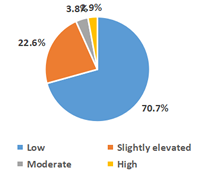
Results: The participants included 111 males and 128 females respectively. The average age of participants was 38.3±13.9 years. Majority (70.7%) of participants had low risk score for diabetes. Mild and moderate risk scores were obtained in 22.6% and 3.8% of participants respectively. The average risk score for Type 2 DM using FINDRISC score was 4.9±3.9 with a range of 0.0 to19.0. The predictors of type 2 DM were: age ≥ 38 years, non-involvement in exercise for 30 minutes for a period of 5 days, higher than normal BMI, and central obesity. The self- reported prevalence of diabetes was 3.9%. Among those with family history of diabetes, 4.2%, 4.6% and 2.9% involved the father, mother and siblings respectively. About 54.8% of 221 respondents have never been screened for diabetes
Conclusion: FINDRISC scoring can be used to obtain a 10-year risk of developing diabetes mellitus thus, very effective in counselling participants. Dental clinic can be used as a focal point for DM screening.
Downloads
Article Details
Section

This work is licensed under a Creative Commons Attribution-NonCommercial-ShareAlike 4.0 International License.
The Journal is owned, published and copyrighted by the Nigerian Medical Association, River state Branch. The copyright of papers published are vested in the journal and the publisher. In line with our open access policy and the Creative Commons Attribution License policy authors are allowed to share their work with an acknowledgement of the work's authorship and initial publication in this journal.
This is an open access journal which means that all content is freely available without charge to the user or his/her institution. Users are allowed to read, download, copy, distribute, print, search, or link to the full texts of the articles in this journal without asking prior permission from the publisher or the author.
The use of general descriptive names, trade names, trademarks, and so forth in this publication, even if not specifically identified, does not imply that these names are not protected by the relevant laws and regulations. While the advice and information in this journal are believed to be true and accurate on the date of its going to press, neither the authors, the editors, nor the publisher can accept any legal responsibility for any errors or omissions that may be made. The publisher makes no warranty, express or implied, with respect to the material contained herein.
TNHJ also supports open access archiving of articles published in the journal after three months of publication. Authors are permitted and encouraged to post their work online (e.g, in institutional repositories or on their website) within the stated period, as it can lead to productive exchanges, as well as earlier and greater citation of published work (See The Effect of Open Access). All requests for permission for open access archiving outside this period should be sent to the editor via email to editor@tnhjph.com.
How to Cite
References
1.World Health Organization, Geneva (2019). Classification of Diabetes mellitus. Licence: CCBY-NC-SA 3.0 IGO
2.World Health Organization. (2024). Diabetes. Available on https://www.who.int.health. Accessed on 20th August 2024
3.Leite RS, Marlow NM and Fernandes JK. Oral health and Type 2 Diabetes. Am J Med Sci 2013; 345: 271-273
4.Lau P, Tran A, Chen M, Boyce E, Martin R, Calache H. Inter-professional diabetes and Oral health management: what do primary healthcare professionals think? F1000 Res 2021; 10: 339
5.Loe H. Periodontal disease. The sixth complication of diabetes. Diabetes Care, 1993; 16: 329-334
6.Altamash M, Klinge B, Engstrom PE. Periodontal treatment and HbA1C levels in subjects with diabetes mellitus. J Oral Rehab 2016; 43: 31-38
7.Schmalz G, Wolf C, Merie C Kottman T, Haak R, Ziebolz D. Evaluation of a questionnaire-based diabetes screening concept in German patients with stage III or IV periodontitis: A practice- based study. J Periodontol 2021; 92(8): 1163-1170. doi: 10.1002/JPER.20-0297.
8.Liccardo D, Cannavo A, Spanuolo G, Ferrara N, Cittadini A, Rengo C, Rengo G. Periodontal disease: A risk factor for diabetes and cardiovascular disease. Int J Mol Sci 2019; 20: 1414
9.Genco RJ, Grossi SG, Ho A, Nishimura F, Murayama Y. A proposed model linking inflammation, to obesity, diabetes, and periodontal infections. J Periodontol. 2005; 76: 2075-2084
10.Carrizales-Sepulveda EF, Ordaz- Farias A, Vera-Pineda R, Flores-Ramirez R. Periodontal disease, systemic inflammation and the risk of cardiovascular disease. Heart Lung Circ. 2018; 27: 1327-1334
11.Ziebolz D, Bauwe I, Schimdt J. Diabetes screening in dental practice using the Find-Risk questionnaire- A practice-based pilot study. Oral Health Prev Dent. 2019; 17: 147-156
12.Bould K, Scott SE, Dunne S, Asimakopoulou. Uptake of screening for type 2 diabetes risk in general dental practice; an exploratory study. Br Dent J 2017; 222: 293-299.
13. Lindstrom J and Tuomilhto J. The diabetes risk score: A practical tool to predict type 2 diabetes risk. Diabetes Care 2003;26: 725-731
14. Makrilakis K, Liatis S Grammatikou S et al. Validation of the Finnish Diabetes Risk Score (FINDRISC) questionnaire for screening for undiagnosed type 2 diabetes, dysglycemia and the metabolic syndrome inn Greece. Diabetes & Metabolism 2011; 27: 144-151.
15.Mugume IB, Wafula ST, Kadengye DT, Van Olmen J. Performance of a Finnish Diabetes Risk Score in detecting undiagnosed diabetes among Kenyans aged 18- 69 years. PLoS One 2023; 18(4): e0276858. doi; 10.1371/journal.pone.0276858
16.Alebiosu OC, Familoni OB, Ogunsemi OO, Raimi TH, Balogun WO, Odusan O et al,. Community based diabetes risk assessment in Ogun state, Nigeria (World Diabetes Foundation project 08-321). Indian J Endocrinol & Metab. 2013; 17(4): 634-658.
17. Opara BC, Ijeh II, Ejike CEC, Nnamudi AC. Diabetes risk score assessment and some adiposity indices in a young adult population in Umudike, Nigeria African Journal of Diabetes Medicine. 2020; 28(1): 1-7.
18.Ugwueze CV, Nnolim BI, Anikpo NC, Onyekachi KE, Onah CK, Chukwu OE. Risk assessment for type 2 diabetes mellitus among participants in a market survey at Ebonyi State, South East Nigeria, using Finish diabetes Risk score questionnaire. Nigeria J Med 2022; 31:530- 534
19.Eishebiny A, Alrashed A, Albuwaydi Z, Aljassim S, Alhammad F, Alhajji R. An assessment of the 10- risk of developing type 2 diabetes among Saudi Adults based on the Finnish Diabetes Risk Score. Cureus 2022; 14: e32034.
20.Cochran WG. Sampling Techniques, 2nd Ed New York: John Wiley and sons , Inc. 1963: 330
21.Nyenwe EA, Odia OJ, Ihekwaba AE, Ojule A, & Babatunde S. Type 2 diabetes in adult Nigerians: a study of its prevalence and risk factors in Port Harcourt, Nigeria. Diabetes Res Clin Pract. 2003; 62: 177-185.
22.Allazam MF, Darwazeh AMG, Hassona YM, Khader YS. Diabetes mellitus risk among Jordanians in dental setting: a cross-sectional study. Int Dent J. 2020; 70(6): 482-488doi:10.1111/idj.12591
23.Nnamudi AC, Orhue NEJ & Ijeh I.I. Assessment of the FINDRISC tool in predicting the risk of developing type 2 diabetes mellitus in a young adult Nigerian population. Bull Natl Res Cent, 2020;44:186.https://doi.org/10.1186/s42269-020-00440-7.
24.Cosansu G, Celik S, Ozcan S, Olgun N, Yildirim N, Demir HG. Determining type 2 diabetes risk factors for the adults: A community based study from Turkey. Primary Care Diabetes, 2018; 12(5): 409-415
25.Saglik BB, Basvuran K, Diyabet Y, Skorlari R, Bir Kesitel,, Evcimen CH. Original research diabetes risk score of adult applications to primary health care centre; A cross-sectional study. Van Sag. Bil. Derg. 2023; 16(1): 53-79.
26.Agaba PA, Gimba ZM, Akanbi MO, Ocheke AN, Agaba EI. Prevalence of self –reported pre- hypertension and diabetes and associated risk factors among university employees in Jos, Nigeria. Highland Med Res J 2016; 16: 61-65.
27.Tagoe HA. Household burden of chronic diseases in Ghana. Ghana Med J, 2012; 46: 54-58
28.Azuogu B, Madubueze U, Una A, Okedo –Alex I & Azuogu V. Prevalence and knowledge of risk factors for diabetes mellitus among secondary school teachers in Abakaliki Educational Zone, Nigeria. J Epidemiol Soc Nig, 2020; 2(2): 37- 44.
29.Dahiru T, Aliyu AA, Shehu AU. A review of population -based studies on diabetes mellitus in Nigeria. Sub-Saharan Afr J Med 2016; 3: 59-64.
30.Gudjonsdottir H, Tynelius P, Stattin NS, Mendez DY, Lager A, Brynedal B. Undiagnosed type 2 diabetes is common-intensified screening of established risk groups is imperative in Sweden: the SDPP cohort. BMC Medicine 2024; 22: 168. https://doi.org/10.1186/s12916-024-03393-0
31.Ogurtsova, K., Guariguata, L., Barengo, N.C., Ruiz, P.L.D., Sacre, J.W. and Karuranga, S. (2022). IDF diabetes Atlas: Global estimates of undiagnosed diabetes in adults for 2021. Diabetes Res Clinical Pract 183 :109118.