
Acute Effects of Steady-State Generator and Intermittent Traffic Noise on Attention and Short-Term Memory in Nigerian University Students: A Counterbalanced Experimental Study.
Article Sidebar
Main Article Content
Abstract
Objective: This study examined the acute effects of steady-state and intermittent noise on attention and short-term memory among Nigerian university students.
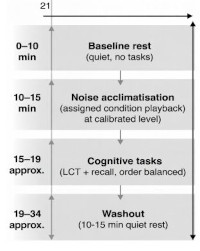
Methods: A counterbalanced within-subjects experimental design was employed with 40 undergraduate students from UNILORIN, who were exposed to three conditions: quiet control (~35 dB[A]), steady-state noise, and intermittent noise, all calibrated at 70 dB(A). Attention was assessed using the Letter Cancellation Test (LCT), while short-term memory was measured using immediate free recall of ten semantically unrelated words. Linear mixed-effects models adjusting for individual and session-level covariates were applied, with supplementary repeated-measures ANOVA (Analysis of Variance).
Results: Linear mixed-effects models showed no significant deleterious effects of steady-state or intermittent noise on attention or short-term memory compared with the quiet condition. Supplementary repeated-measures ANOVA identified statistical differences in attention scores, but these effects were small and attenuated after covariate adjustment. Stress emerged as a significant negative predictor of both cognitive outcomes, while noise sensitivity showed a positive association with attentional performance. These findings suggest habituation or arousal-related resilience to noise exposure, with stress exerting a stronger influence on cognitive performance than noise itself.
Conclusion: Acute exposure to generator and traffic noise at 70 dB(A) does not significantly impair attention or memory among Nigerian university students. Interventions targeting stress reduction may offer greater cognitive benefits than short-term noise control alone.
Downloads
Article Details
Section

This work is licensed under a Creative Commons Attribution-NonCommercial-ShareAlike 4.0 International License.
The Journal is owned, published and copyrighted by the Nigerian Medical Association, River state Branch. The copyright of papers published are vested in the journal and the publisher. In line with our open access policy and the Creative Commons Attribution License policy authors are allowed to share their work with an acknowledgement of the work's authorship and initial publication in this journal.
This is an open access journal which means that all content is freely available without charge to the user or his/her institution. Users are allowed to read, download, copy, distribute, print, search, or link to the full texts of the articles in this journal without asking prior permission from the publisher or the author.
The use of general descriptive names, trade names, trademarks, and so forth in this publication, even if not specifically identified, does not imply that these names are not protected by the relevant laws and regulations. While the advice and information in this journal are believed to be true and accurate on the date of its going to press, neither the authors, the editors, nor the publisher can accept any legal responsibility for any errors or omissions that may be made. The publisher makes no warranty, express or implied, with respect to the material contained herein.
TNHJ also supports open access archiving of articles published in the journal after three months of publication. Authors are permitted and encouraged to post their work online (e.g, in institutional repositories or on their website) within the stated period, as it can lead to productive exchanges, as well as earlier and greater citation of published work (See The Effect of Open Access). All requests for permission for open access archiving outside this period should be sent to the editor via email to editor@tnhjph.com.
How to Cite
References
1.Souliby A, Mahammedi F. Baddeley and Hitch's Multi-Component Model of Working Memory analytical study. Al-Siraj Mag Educ Community Issues. 2024 Jun 12;8(2):19-32. https://asjp.cerist.dz/index.php/en/article/246370
2.Monteiro R, Tomé D, Neves P, Silva D, Rodrigues MA. The interactive effect of occupational noise on attention and short-term memory: A pilot study. Noise and Health. 2018 Sep-Oct;20(96):190-198. doi: 10.4103/nah.NAH_3_18.
3.Hammer MS, Fan Y, Hammer SS, Swinburn TK, Weber M, Weinhold D, Neitzel RL. Applying a novel environmental health framework theory (I-ACT) to noise pollution policies in the United States, United Kingdom, and the Netherlands. Journal of environmental planning and management. 2018 Oct 15;61(12):2111-32. https://doi.org/10.1080/09640568.2017.1385448.
4.Hahad O, Prochaska JH, Daiber A, Muenzel T. Environmental noise‐induced effects on stress hormones, oxidative stress, and vascular dysfunction: Key factors in the relationship between cerebrocardiovascular and psychological
disorders. Oxidative medicine and cellular longevity. 2019;2019(1):4623109. https://doi.org/10.1155/2019/4623109.
5.Daiber A, Kröller‐Schön S, Frenis K, Oelze M, Kalinovic S, Vujacic‐Mirski K, Kuntic M, Bayo Jimenez MT, Helmstädter J, Steven S, Korac B. Environmental noise induces the release of stress hormones and inflammatory signaling molecules leading to oxidative stress and vascular dysfunction—Signatures of the internal exposome. Biofactors. 2019 Jul;45(4):495-506. https://doi.org/10.1002/biof.1506.
6.Clark C, Head J, Haines M, van Kamp I, van Kempen E, Stansfeld SA. A meta-analysis of the association of aircraft noise at school on children's reading comprehension and psychological health for use in health impact assessment. Journal of Environmental Psychology. 2021 Aug 1;76:101646. https://doi.org/10.1016/j.jenvp.2021.101646
7.Peng P, Barnes M, Wang C, Wang W, Li S, Swanson HL, Dardick W, Tao S. A meta-analysis on the relation between reading and working memory. Psychological bulletin. 2018 Jan;144(1):48. https://doi.org/10.1037/bul0000124
8.Kassaw C, Demareva V. Psychosocial and cognitive predictors of academic achievement among higher education students in Southern Ethiopia. PLoS One. 2025 Nov 6;20(11):e0335968. doi: 10.1371/journal.pone.0335968. PMID: 41196871; PMCID: PMC12591494.
9.Molnár, G., & Kocsis, Á. (2023). Cognitive and non-cognitive predictors of academic success in higher education: a large-scale longitudinal study. Studies in Higher Education, 1–15. https://doi.org/10.1080/03075079.2023.2271513
10.Li X, AlWadi BM, Ahmad A, Dukhaykh S, Khan I. Igniting success: how growth mindset fuels academic achievement through self-belief and strategic effort. BMC Nurs. 2025 Dec 22;24(1):1507. doi: 10.1186/s12912-025-04237-9. PMID: 41430222; PMCID: PMC12751792.
11.Spencer H. The principles of psychology. InScientific Methodology in Nineteenth Century Britain 2025 Sep 25 (pp. 163-178). Routledge.
12.Agbo COA. Noise Pollution in Nigeria’s Institutions of Higher Learning: A Review. J. Eng. Res. Rep. [Internet]. 2020 Oct. 30;18(1):8-21. https://doi.org/10.9734/jerr/2020/v18i117198.
13.Agaja TM, Akande GP. Impact of noise pollution on the academic performance of students in the university of Ilorin’s learning environment, Nigeria. FUDMA J Earth Environ Sci. 2024 Dec. 31;1(2):42-57. https://doi.org/10.33003/jees.2024.0102/05.
14.Ayodeji Olawumi B, Abubakar I. Perception of Students on Noise Level Influence of Selected Evening Reading Classes in Umaru Ali Shinkafi Polytechnic, Sokoto. GJBE [Internet]. 2024 Sep. 2;6(1):29-38. https://gjbeses.org/ses-journal/index.php/gjbe/article/view/45.
15.NESREA. (2009). National Environmental (Noise Standards and Control) Regulations, 2009. Federal Republic of Nigeria Official Gazette.
16.Francis A, Sani S, Abubakar A. Evaluation of noise levels in Ahmadu Bello University main campus, Samaru, Zaria, Nigeria. J Occup Saf Environ Health. 2023;5(1):46-55. https://sosehnigeria.org/wp-content/uploads/2023/08/2023_PAPER-04.pdf
17.Dzhambov AM. Noise sensitivity: a neurophenomenological perspective. Medical hypotheses. 2015 Nov 1;85(5):650-5. https://doi.org/10.1016/j.mehy.2015.08.006
18.Sörqvist P. On interpretation and task selection in studies on the effects of noise on cognitive performance. Frontiers in psychology. 2014 Oct 30;5:1249. https://doi.org/10.3389/fpsyg.2014.01249
19.Schlittmeier SJ, Feil A, Liebl A, Hellbr Ck JR. The impact of road traffic noise on cognitive performance in attention-based tasks depends on noise level even within moderate-level ranges. Noise Health. 2015 May-Jun;17(76):148-57. doi: 10.4103/1463-1741.155845.
20.Brink M, Schäffer B, Vienneau D, Foraster M, Pieren R, Eze IC, Cajochen C, Probst-Hensch N, Röösli M, Wunderli JM. A survey on exposure-response relationships for road, rail, and aircraft noise annoyance: Differences between continuous and intermittent noise. Environment international. 2019 Apr 1;125:277-90.
https://doi.org/10.1016/j.envint.2019.01.043
21.Brocolini L, Parizet E, Chevret P. Effect of masking noise on cognitive performance and annoyance in open plan offices. Applied acoustics. 2016 Dec 15;114:44-55. https://doi.org/10.1016/j.apacoust.2016.07.012
22.Yerkes RM, Dodson JD. The Relation of Strength of Stimulus to Rapidity of Habit-Formation. Journal of Comparative Neurology and Psychology, 18, 459-482. http://dx.doi.org/10.1002/cne.920180503.
23.Leist L, Lachmann T, Klatte M. Impact of irrelevant speech and non-speech sounds on serial recall of verbal and spatial items in children and adults. Scientific reports. 2025 Jan 14;15(1):1951. https://doi.org/10.1038/s41598-025-85855-w
24.Meteyard L, Davies RA. Best practice guidance for linear mixed-effects models in psychological science. Journal of Memory and Language. 2020 Jun 1;112:104092. https://doi.org/10.1016/j.jml.2020.104092
25.Szalma JL, Hancock PA. Noise effects on human performance: a meta-analytic synthesis. Psychol Bull. 2011 Jul;137(4):682-707. https://doi.org/10.1037/a0023987